
Dr. Doug Kavanagh
The following is a post from Dr. Doug Kavanagh, co-founder and medical director of OceanMD and practising family physician with the North York Family Heath Team.
As a family physician, I have never felt there was a shortage of good ideas in healthcare.
What we are short on is room to test those ideas quickly, responsibly, and in real clinical contexts.
That gap matters. In healthcare, even strong ideas can move slowly once they enter formal product planning, procurement processes, privacy reviews, competing priorities, and the understandable caution that comes with working in a sensitive, high-stakes environment. Much of that caution is necessary. Ocean’s core platform works in a context where privacy, security, and trust are not secondary considerations. They are foundational to the relationship we have with clinics and health system partners. That is especially true as new AI capabilities begin to create real opportunities, but also real questions, for digital health. If we want to improve care in practical ways, we need a disciplined place to explore those new workflows before they are fully hardened into product.
That is a big part of why we created Ocean Labs.
Why Ocean Labs exists
Ocean Labs is a space for focused experimentation around digital health workflows. The goal is not to chase novelty for its own sake, and it is not to build technology detached from the realities of care delivery.
“The goal is to identify real operational bottlenecks, prototype ways to address them, and learn quickly whether an idea deserves to be refined, redirected, or set aside.”
In practice, that means creating targeted initiatives for specific users and specific workflow problems. Sometimes the right vehicle is a lightweight extension. Sometimes it is a standalone application. Sometimes it is simply a prototype that helps us understand where the real friction lies. What matters most is whether we can test a clear hypothesis in a real environment and come away with better answers.
AI is part of that strategy, but in a deliberate way. There is real potential for AI to reduce administrative burden, improve triage, summarize complex information, and make digital workflows more responsive to the needs of different care settings. At the same time, Ocean has earned trust by taking privacy seriously and by supporting sensitive workflows that depend on secure handling of personal health information. We should not take that trust for granted. Ocean Labs gives us a way to explore AI capabilities through informed, opt-in partnerships where the use case is clear, the safeguards are explicit, and the learning can happen responsibly before any broader product decision is made.
That kind of work is important because many of the problems worth solving in digital health are not theoretical. They are operational. They show up in intake backlogs, repetitive administrative steps, inconsistent triage, fragmented communication, and hours of staff time spent moving information from one place to another. These are not glamorous problems, but they are exactly the kinds of problems that shape patient access and provider capacity every day.
What challenges will Ocean Labs explore
Ocean Labs is best suited to workflow problems that meet a few conditions.
- The problem should be real and repeated. We are not looking for one-off novelty projects. We are looking for friction that shows up again and again in clinics, referral pathways, and patient or provider interactions.
- The problem should be narrow enough to test. If a concept is too broad, it becomes hard to evaluate. A well-scoped experiment gives us a chance to learn quickly and gather concrete feedback.
- The work should respect the realities of Canadian healthcare. That means privacy matters. Reliability matters. Human oversight matters. And clinical nuance matters. If an idea only works under perfect conditions, it is probably not ready for real care settings.
Personally, I am most excited by ideas that give time back to healthcare teams, reduce avoidable administrative load, and make digital workflows feel more practical and more humane. Sometimes the biggest improvement is not a dramatic new capability. Sometimes it is removing a repetitive step, shortening a queue, or helping the right information reach the right person at the right time.
A great example: Autorouter
One of the clearest examples in Ocean Labs today is Autorouter.
Autorouter is an Ocean Labs project focused on eReferral and eConsult intake. It monitors referral events, analyzes referral content, including form data and attachments, and applies configurable rules to support routing actions. The underlying problem is straightforward: referral intake teams often deal with high volumes, variable documentation, and triage decisions that are both repetitive and important. That work takes time, and it is not always handled consistently when teams are under pressure.
Autorouter is designed to help with exactly that kind of workflow friction.
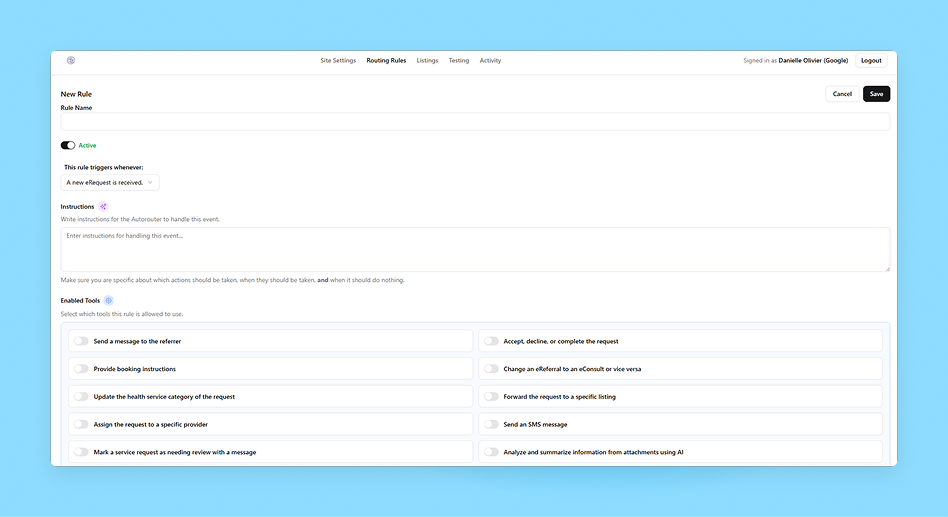
The interesting part is not simply that AI is involved. The interesting part is that the AI can be shaped around real clinic rules. In one setting, that might mean detecting urgent cardiology referrals that mention exertional chest pain or syncope and triggering an alert for immediate review. In another, it might mean automatically accepting a clearly eligible rheumatology injection referral, or rejecting an obstetrical ultrasound referral at a site that does not provide that service. In a geriatrics context, it may be more useful to summarize incoming documentation for review rather than make a fully automated routing decision.
That last point is important. Innovation in digital health should not assume every problem needs full automation. In some cases, the best outcome is automatic action. In others, it is better prioritization, a clearer summary, or narrowing a complex decision down to two reasonable options for a human reviewer. We are seeing that distinction come up in real conversations. For example, one regional geriatric intake group has shown interest in using Autorouter to reduce the burden of geographic and program-based routing while still keeping a human in the loop.
That is the kind of future state that excites me: not replacing judgement, but supporting it in a way that saves time, improves consistency, and helps teams work at the top of their capacity.
Principles that matter while innovating in healthcare
As we explore new ideas in digital health, a few principles are worth keeping in mind.
- Stay grounded in actual workflow. If a tool does not fit the day-to-day reality of care delivery, it will not matter how impressive the technology is.
- Be honest about where human review belongs. Healthcare is full of nuance, and good innovation should respect that. Automation should be introduced carefully, in places where it genuinely improves speed or consistency without obscuring accountability.
- Focus on practical value over hype. In healthcare, the strongest innovation stories are usually not the loudest ones. They are the ones that quietly remove friction, improve access, and make it easier for teams to do good work.
Why experiment outside the product?
There is an important reason to create some space outside the core product while exploring these ideas.
A production platform has to be stable, broadly usable, well supported, and thoughtfully governed. That is as it should be. But early innovation often needs a different environment. It needs the ability to test narrow use cases, work closely with a handful of early partners, and adapt quickly as the real problem becomes clearer.
When you separate that learning layer from the main product, a few benefits emerge. You can prototype faster. You can tailor an initiative to a specific audience without overcommitting the broader platform. You can learn from edge cases earlier. You can evaluate where AI is genuinely helpful and where it introduces more risk than value. And just as importantly, you can decide more honestly when an idea is not yet ready.
For me, that is one of the most valuable roles Ocean Labs can play: not just accelerating new concepts, but improving the quality of our decisions about what should eventually become a durable part of the product experience.
Looking ahead
My hope is that Ocean Labs helps create a more effective bridge between good ideas and real-world impact.
For providers and clinic teams, that could mean less administrative burden and more time for care. More importantly, it could mean workflows that feel better matched to the reality of a specific clinic, specialty, or program instead of forcing everyone into the same generic process. Too often in healthcare, software succeeds at scale by standardizing aggressively, but in doing so it can leave individual clinicians and programs working around workflows that do not quite fit. Ocean Labs creates an opportunity to explore more adaptable, more configurable tools around those local needs without giving up the safety, connectivity, security, and privacy that mature platforms are meant to provide.
“What excites me is the possibility of making digital health systems more adaptable at the edges while preserving the trust, privacy, and connectivity that make core platforms valuable in the first place.”
For health systems and governments, I hope that translates into a better model for innovation: not replacing trusted infrastructure with fragmented point solutions, but extending it in a more flexible way. If we can prove that targeted, opt-in innovations can sit alongside established systems and still respect governance, privacy, and interoperability requirements, then it becomes easier to improve access and operational efficiency without destabilizing the foundation underneath. For governments and health systems, I hope this creates a path to innovation that is more modular and responsive, without sacrificing governance or fragmenting the care environment.
For patients, the benefit should be simpler and more responsive care pathways. They should not have to feel the weight of administrative complexity behind the scenes. If Ocean Labs is successful, the result will be fewer delays, clearer handoffs, and digital processes that work more intelligently on behalf of the people trying to access care.
There is still a great deal to learn, and that is exactly the point. Ocean Labs is not about pretending we already have all the answers. It is about creating the right environment to ask better questions, test them responsibly, and move promising ideas forward with clearer evidence. That is the kind of digital health innovation that interests me most: practical, measurable, closely tied to the realities of care, and thoughtful about how powerful technology like AI should be introduced into trusted clinical systems.